Sentry Visibility Sensor.

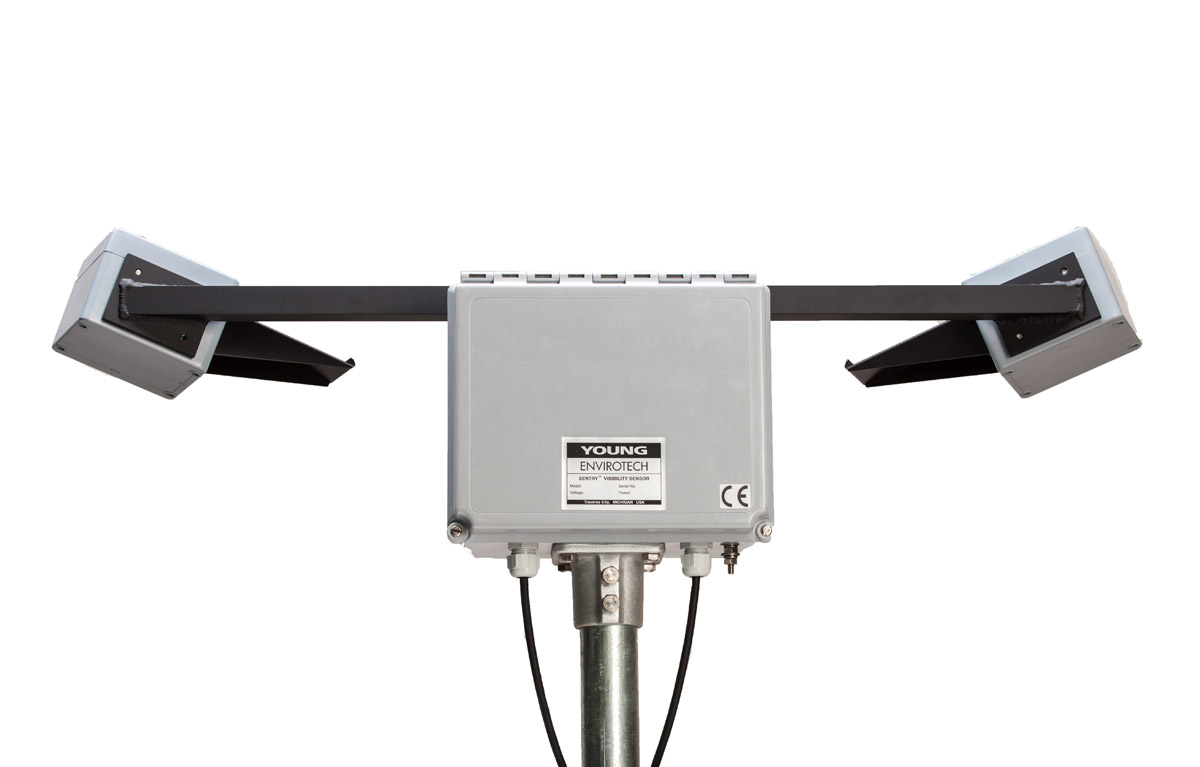
The Sentry Visibility Sensor measures atmospheric visibility (meteorological optical range) by determining the amount of light scattered by particles (smoke, dust, haze, fog, rain and snow) in the air that passes through the sample volume. Performance in all weather conditions was a design prerequisite for the Sentry. An integrated, one-piece housing design keeps all cabling internal to the sensor for the ultimate protection against the elements. The sensor housing is made from anodised aluminium and the enclosures are rugged, UV-resistant fibreglass rated to IP66. The windows use continuous-duty anti-dew heaters, and thermostatically controlled external hood heaters are offered for protection in extreme environments. All power and signal lines to the Sentry are protected with surge and EMI filtering to help guarantee uninterrupted service for the life of the sensor.
| Range | 30 m to 16 km (other ranges available) |
|---|---|
| Accuracy | ±10% RMSE |
| Time constant | 60 sec |
| Scatter angle | 42° nominal |
| Source | 850 nm LED |
| Outputs | 0-10 VDC standard 0-5 VDC optional Output control board optional with: 4-20 mA, 4-20 mA isolated, control relay and/or diagnostic relay Microprocessor board with RS-232 optional |
| Power | AC version: 100-240 VAC, 14 VA; 70 VA with hood heaters DC version: 10-36 VDC, 6 VA; 18 VA with hood heaters |
| Environment | Temperature: -40 to 60°C Humidity: 0-100% Protection: IP66 (NEMA-4X) |